Embedded Sound Recognition: From Algorithm Selection to Production Deployment
Bringing sound recognition to an embedded device is a journey that spans algorithm research, model optimization, firmware integration, and factory testing. This guide walks through the entire pipeline, with concrete advice for each stage.
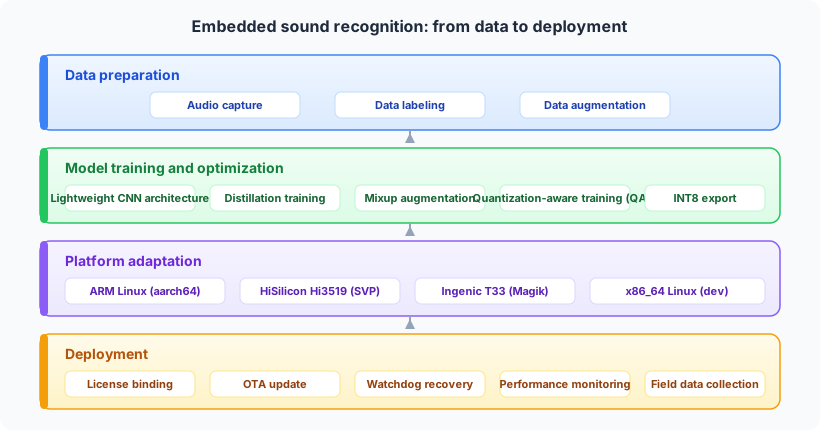
1. Algorithm Selection: Know Your Constraints
Before evaluating any model, define your project's hard constraints:
Hardware budget. What SoC are you targeting? An ARM Cortex-A53 @ 1GHz has roughly 50–100 MHz to spare for audio inference after running the main application (streaming, UI, networking). A dedicated NPU (HiSilicon SVP, Ingenic Magik) changes the picture entirely — you can run larger models at near-zero CPU cost.
Latency requirement. Real-time alerting (baby cry, glass break) needs inference under 20ms per 5-second window. Batch processing (e.g., nightly snore analysis) can tolerate 200ms+.
Accuracy floor. What false-alarm rate will your end customer accept? A baby monitor that alerts on every TV jingle will be returned. For medical-adjacent use cases (CPD, sleep apnea screening), recall matters most.
Model Architecture Comparison
Our recommendation: For most camera and IoT SoCs (Hi3519, T31/T33, RV1109), start with an MFCC + lightweight CNN architecture. It offers the best accuracy-to-size ratio and maps well to NPU hardware.
2. Data Pipeline: The Hidden Bottleneck
Your model is only as good as your training data. For production sound detection, you need:
Positive samples. At least 5,000–10,000 labeled events per sound type, sourced from diverse recording conditions (distance, angle, room acoustics, background noise).
Negative samples. Crucially, these should come from your actual deployment environment. A baby cry model trained on clean studio recordings will fail in the real world with TV noise, AC hum, and parent footsteps. Collect at least 1:1 negative-to-positive ratio from the field.
Data augmentation strategy. The single highest-impact technique we've found:
• Noise mixing: superimpose background noise at 0–10 dB SNR
• Speed perturbation: ±5% to ±15% playback speed
• Room impulse response (RIR) convolution: simulate different room acoustics
• Band-stop filtering: simulate poor microphone frequency response
• Gain augmentation: vary input level by ±6 dB
3. Training and Optimization
Quantization: FP32 → INT8
Converting from FP32 to INT8 reduces model size by 4× and speeds up inference by 2–3× on ARM NEON/SDOT hardware. With proper quantization-aware training (QAT), accuracy loss is typically < 0.5%.
Distillation
Use a larger teacher model (CED, BEATs) to guide a smaller student model. This can recover 2–5% accuracy lost to shrinking the model. In our training pipeline, distillation reduced the gap between a 1.2 MB student and a 200 MB teacher to just 0.3% on the test set.
4. Platform Adaptation
Each target SoC requires specific optimization:
Generic ARM Linux (aarch64). Pure C FP32 inference with optional NEON INT8. Easiest path — compile with ARM GCC, link libsoundetect.so, deploy.
HiSilicon Hi3519DV500 (SVP NNIE). The SVP accelerator requires models to be converted to a specific instruction format (".wk" file). Our SDK handles this conversion. The NNIE achieves 0.3–0.5 TOPS, sufficient for real-time detection of 3–4 sound types simultaneously.
Ingenic T33 (Magik NPU). Magik uses a proprietary compilation toolchain. Models must be exported to TFLite format, then compiled by the Magik toolchain. The NPU runs at ~0.6 TOPS. Our T33 demo shows the full integration.
x86_64 Linux. Use for development and testing. No NPU needed — pure C FP32 is fast enough on modern x86 CPUs.
5. Production Deployment Checklist
Before shipping, verify each item:
License enforcement. — Bind license to device unique ID (MAC + chipID hash). Implement offline verification with grace period for OOB setup.
OTA model updates. — Design your firmware to accept model file updates without a full firmware flash. Keep a fallback model in a separate partition.
Watchdog recovery. — If the sound detection process crashes, the watchdog should restart it automatically without affecting the main application.
Performance monitoring. — Log inference latency and CPU usage to a health metric. Alert if latency exceeds 2× baseline — this often indicates memory fragmentation or thermal throttling.
Field data collection. — Optionally allow uploading anonymous positive detections for continuous model improvement (with customer consent).
6. Common Pitfalls
Pitfall 1: Testing only in the lab. Lab accuracy rarely translates to the field. Run a 2-week field trial with 10+ devices in real homes before committing to production.
Pitfall 2: Underestimating mic variability. The difference between a Knowles SPH0645 and a generic MEMS mic can drop accuracy by 5–10%. Validate with your actual BOM microphone.
Pitfall 3: Ignoring thermal throttling. Continuous audio processing on a passively cooled SoC can cause thermal throttling after 30–60 minutes. Profile sustained inference speed, not just cold-start benchmarks.
Pitfall 4: One-model-fits-all. A model optimized for close-range (1 m) baby cry detection will fail for far-field (5 m) crib monitoring. Consider separate models or multi-condition training for different deployment scenarios.
7. Build vs. Buy Decision
Conclusion
Successful embedded sound recognition deployment requires balancing accuracy, model size, latency, and production robustness. Start with a proven architecture (lightweight CNN + MFCC), invest in realistic training data, quantize early, and test extensively in the target environment. The difference between a demo and a shipped product is in the deployment details.
If you're evaluating options for your next product, we offer a trial SDK with pre-compiled libraries for ARM Linux, HiSilicon SVP, and Ingenic Magik platforms — along with integration support to get you from zero to a running demo in under a week.
Want to try the detection yourself?