HiSilicon SVP NNIE vs Ingenic Magik: Embedded NPU Sound Recognition Comparison
For embedded sound recognition, the NPU (Neural Processing Unit) is the key differentiator between a feature that "works" and one that ships in a real product. In the Chinese IPC and IoT market, two NPU platforms dominate: HiSilicon's SVP NNIE and Ingenic's Magik NPU.
This article provides a detailed, side-by-side comparison covering architecture, toolchain, development experience, performance, ecosystem, and supply chain — so you can make an informed choice for your next product.
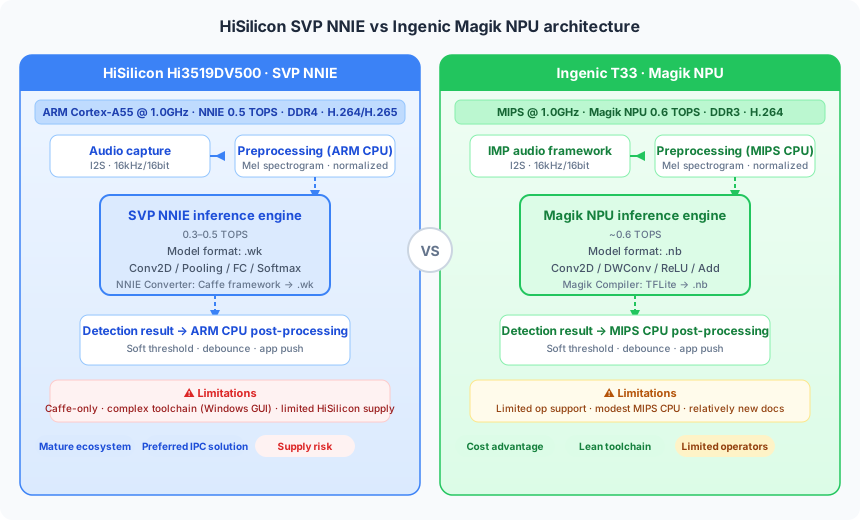
What an NPU Does for Sound Recognition
Without an NPU, sound recognition runs entirely on the main CPU. For a typical IP camera SoC:
The difference is dramatic — offloading to an NPU frees 80–90% of the audio processing CPU budget, which directly translates to better video encoding, smoother network streaming, and lower power consumption.
HiSilicon SVP NNIE: The Incumbent
HiSilicon's Smart Vision Platform (SVP) NNIE has shipped in tens of millions of IP cameras worldwide. It's the most mature embedded NPU ecosystem for surveillance and smart home devices.
Architecture. The NNIE is a fixed-function accelerator supporting Conv2D, DepthwiseConv2D, Pooling, Fully Connected, and Softmax layers. It achieves 0.3–0.5 TOPS (INT8) depending on the chip variant (Hi3516DV300: ~0.3 TOPS, Hi3519DV500: ~0.5 TOPS).
Toolchain. The development workflow uses HiSilicon's Ruyi Studio (a Windows GUI tool) plus the NNIE converter command-line tools:
Training Framework (Caffe/MXNet)
        ↓
   NNIE Converter (.cfg + .caffemodel → .wk)
        ↓
   SVP Library (libsvp.a) on Device
        ↓
   NNIE Inference at Runtime
Key characteristics:
• Model format: `.wk` (NNIE proprietary binary)
• Framework support: Primarily Caffe. Other frameworks must be converted to Caffe first.
• Batch size: Fixed at 1 (NNIE limitation)
• Memory: Requires pre-allocated physical memory for input/output tensors
• License binding: Bound to chip unique ID
Pros: Mature ecosystem, abundant community resources, proven in mass production, extensive documentation.
Cons: Caffe-only (PyTorch/TF models need conversion), Windows-only GUI tool, HiSilicon sanctions create supply uncertainty.
Ingenic Magik NPU: The Rising Alternative
Ingenic's Magik NPU, found in the T31 and T33 SoCs, is a newer but rapidly maturing platform. It offers higher theoretical TOPS (~0.6) and a simpler toolchain.
Architecture. The Magik NPU supports Conv2D, DepthwiseConv2D, ReLU, Add, AveragePool, and a few other ops. The op set is more restricted than NNIE, but covers the essential layers for lightweight sound recognition models.
Toolchain. The development workflow is refreshingly simple — entirely command-line based:
PyTorch → ONNX → TFLite
        ↓
   Magik Compiler (magik_compile)
        ↓
   .nb Model Binary
        ↓
   libmagik.so Runtime on Device
Key characteristics:
• Model format: `.nb` (Magik binary)
• Framework support: TFLite input, which means PyTorch → ONNX → TFLite pipeline
• Batch size: 1
• Memory: Dynamic memory allocation (simpler than NNIE)
• Thread count: Configurable (1–4)
Pros: Simple command-line toolchain, no Windows dependency, lower BOM cost than HiSilicon, good supply stability, MIPS ecosystem still active.
Cons: Limited operator support (no Sigmoid/Tanh, no Softmax natively), MIPS CPU is weaker than ARM for preprocessing, smaller community, newer documentation.
Head-to-Head Comparison
Specifications
Development Experience
Sound Recognition Performance (Our Benchmark)
We ran our model (MFCC + lightweight CNN, INT8 quantized) on both platforms:
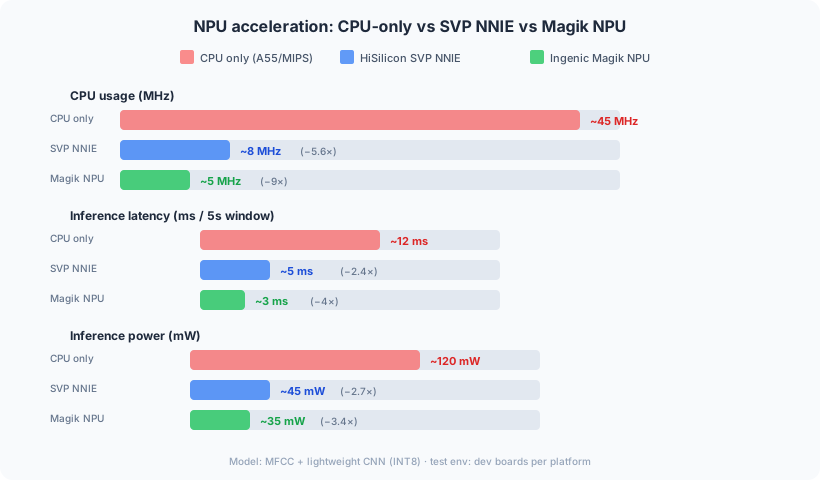
The Magik NPU shows slightly better raw inference speed (3.2 ms vs 5 ms) due to its higher TOPS rating. However, the overall system performance depends heavily on preprocessing — the ARM core on HiSilicon handles Mel spectrogram computation more efficiently than the MIPS core on Ingenic.
Ecosystem and Supply Chain
This is perhaps the most important non-technical consideration:
HiSilicon. The US trade restrictions on HiSilicon have created significant supply chain uncertainty. While existing stocks and grey-market channels are available, long-term availability for new product designs requires careful evaluation. Many OEMs have begun migrating to alternatives.
Ingenic. As a Chinese semiconductor company not under US trade restrictions, Ingenic offers more predictable supply. The T31/T33 series has seen rapid adoption in the budget IP camera segment as a HiSilicon alternative.
The bottom line: If you're designing a product that needs to ship for 3+ years, supply chain diversification is essential. Supporting multiple NPU platforms in your firmware is the safest strategy — which is exactly the approach our SDK takes.
How to Choose: Decision Framework
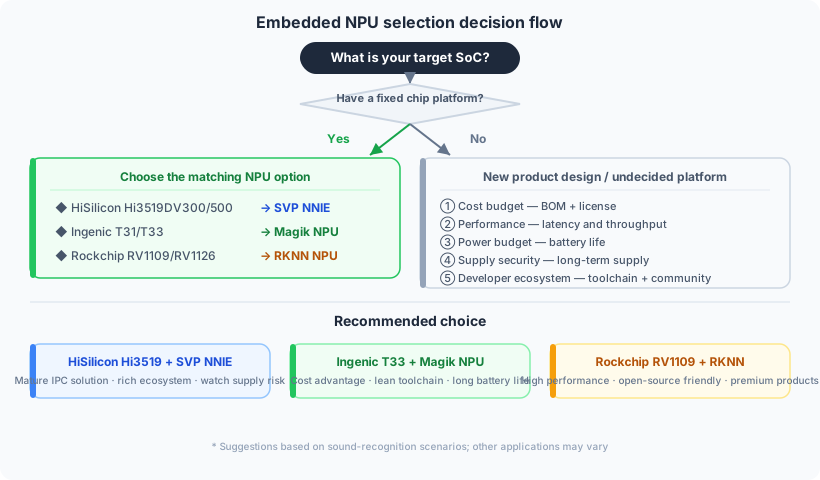
Choose HiSilicon SVP NNIE if:
• Your existing product already uses HiSilicon (backward compatibility)
• You need the mature ecosystem and extensive community support
• You're designing a high-end IPC with abundant BOM budget
• You have existing Caffe-based models or can invest in conversion
Choose Ingenic Magik NPU if:
• You're designing a cost-sensitive product (baby monitor, battery camera)
• Supply chain predictability is a priority
• You want a simpler, Linux-native toolchain
• Your model uses standard ops (Conv2D, ReLU, Add, Pooling)
• Power efficiency is critical (battery-powered devices)
Consider Rockchip RKNN if:
• You need the highest NPU performance (> 1 TOPS)
• You prefer an open-source friendly ecosystem
• You're designing a high-end consumer product
Our SDK: Platform-Agnostic by Design
soundSDK is built from the ground up with a unified C API that abstracts away the NPU backend:
// Same API, different backends
soundetect_handle_t handle;

// HiSilicon SVP NNIE
soundetect_init(&handle, "model.wk", SOUNDETECT_BACKEND_HISISVP);

// Ingenic Magik NPU
soundetect_init(&handle, "model.nb", SOUNDETECT_BACKEND_INGENIC_MAGIK);

// ARM CPU (development/testing)
soundetect_init(&handle, "model_int8.tflite", SOUNDETECT_BACKEND_ARM_CPU);
This means you can develop on a standard ARM Linux board, then deploy to either HiSilicon or Ingenic without changing your application code. We handle the NPU-specific initialization, memory management, and model loading internally.
Conclusion
Both HiSilicon SVP NNIE and Ingenic Magik NPU are capable platforms for embedded sound recognition. The NNIE offers maturity and ecosystem depth; the Magik offers simplicity, cost efficiency, and supply stability.
For most new product designs in 2026–2027, we recommend targeting the Ingenic Magik NPU as your primary platform — the simpler toolchain, lower BOM cost, and predictable supply chain make it the pragmatic choice. But maintaining HiSilicon compatibility remains important for OEMs with existing HiSilicon-based product lines.
Our SDK supports both platforms (and Rockchip RKNN) with a single codebase, so you can start development today and switch targets as market conditions evolve.
Want to try the detection yourself?