Offline Sound Recognition SDK for Edge Devices: An Overview of Nine Embedded ModelsNEW
One Delivery Path for Device-Side Sound Recognition
Smart cameras, baby monitors, sleep devices, pet products and public-safety systems all share the same foundation: sound understanding that runs on the device itself. Instead of stitching together multiple vendors and frameworks, soundSDK delivers nine ready-to-deploy, offline sound recognition models through one unified C SDK — embedded sound recognition for the edge, from IPC sound recognition on cameras to specialised vertical products, covering sound event detection and sound classification without an in-house ML team.
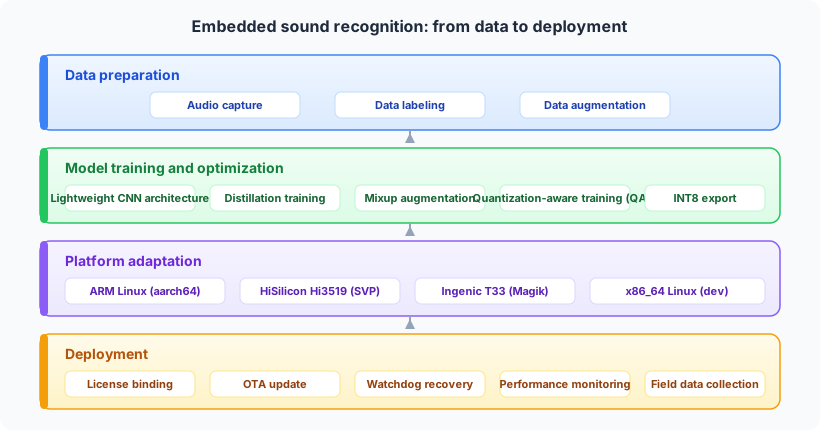
The Nine Models at a Glance
All nine engines share the same detection paradigm — event-based recognition: locate the acoustic event first, verify it with time-frequency evidence, and output onset/offset with a confidence score.
Model Value
The nine models are independent — each can be deployed alone or combined.
1. Baby Cry Detection — turn a passive camera into an active guardian
Cameras and baby monitors have always recorded without judging. If no one is watching the screen — which is most of the time — there is effectively no supervision; the parent glancing at the feed (or woken by a motion alert) is the weak link. Cry detection closes that gap: the device pushes an alert the moment crying starts, so care no longer depends on someone staring at a video feed. That is the difference between a monitor and a guardian.
IPC scenario: — a home or nursery IP camera gains "hears crying" as a first-class alert type, alongside motion and human detection; camera + cry detection becomes one bundle the integrator can sell.
Vertical scenarios: — baby monitors (alert push instead of passive streaming), smart cameras, and in-car child presence detection (CPD) where a cry is the most direct evidence a child is left behind.
2. Snore Detection — turn an overnight recording into readable health data
Snoring is not just noise; it is an audible signal of the sleeper's breathing. A recording alone is of little use to a user, but an overnight snore index, duration share and severity grade turn raw audio into something a person can act on. This is why snore detection flips a sleep product from "records your night" to "understands your night".
IPC scenario: — a bedroom or baby-monitor camera can host snore detection as a wellness feature, reporting nightly statistics over the same device that does video.
Vertical scenarios: — sleep monitors, smart mattresses and pillows, wearables, and dedicated anti-snore devices where detection drives real-time intervention.
3. Dog Bark Detection — add sound context to front-door events
At the front door, video tells you "something moved" but not "why it matters". Barking is the missing context: a visitor triggering a dog, a passing car provoking a bark, or a pet left alone. Judging the situation needs the sound, not just the picture.
IPC scenario: — doorbell and outdoor cameras gain bark alerts as a distinct event type, so a "dog + motion" trigger outranks a plain motion trigger in the notification stack.
Vertical scenarios: — smart doorbells, outdoor/yard cameras, and pet care where owners want to know when their dog is barking.
4. Cat Sound Detection — tell a meow from a cry
A cat's meow sits remarkably close to a baby cry in the spectrum — the most underrated confusion in pet monitoring. Detecting cat vocalizations is as much about *excluding* other sounds as catching them, which is why discrimination in both directions matters.
IPC scenario: — a pet-facing camera or an indoor camera used around pets gains a meow event that does not collide with cry detection running on the same device.
Vertical scenarios: — pet cameras, automatic feeders and litter boxes, and boarding/daycare facilities monitoring animals left alone.
5. Glass Break Detection — catch a break-in in milliseconds
Breaking glass produces a two-stage signature: a sharp impact followed by the shatter of fragments, both on a millisecond scale. Recognizing it means the moment a window shatters, the device already knows — security then focuses on response rather than on watching.
IPC scenario: — security cameras and alarm panels add glass break as an intrusion event that works even when the camera faces the wrong way or the intruder is out of frame.
Vertical scenarios: — home and business security, alarm control panels, and multi-store retail that needs night-time intrusion awareness without staffing a night watch.
6. Alarm Sound Detection — know which alarm is sounding
"An alarm" is not one sound: smoke, CO and car alarms each carry a distinctive pattern. Treating them identically means every alarm looks equally urgent; classifying them first is what makes graded, useful notification possible.
IPC scenario: — an indoor camera or hub hears an alarm and reports *which* alarm, so a smoke alarm is escalated while a brief appliance beep is not.
Vertical scenarios: — home safety, elderly care (a sounding smoke alarm no camera can see) and vehicles.
7. Gunshot Detection — city-scale acoustic sensing
A gunshot is an instantaneous, high-intensity transient followed by echoes — a fingerprint quite unlike most environmental sound. Recognizing it in milliseconds at the edge is what makes wide-area acoustic sensing practical without streaming every microphone to a server.
IPC scenario: — edge sensing nodes make the on-device decision and uplink only events, keeping bandwidth low across a large deployment.
Vertical scenarios: — smart city, campus safety and public-safety systems that need to localize and respond in seconds.
8. Knock Detection — hear the visitors a doorbell misses
Plenty of visitors never touch the button: couriers who tap twice and leave, neighbors knocking in passing, children too short to reach it. A button-only doorbell is blind to all of them; knock recognition fills that blind spot.
IPC scenario: — a doorbell or entry camera reports "someone is knocking" — a far more actionable event than a generic motion clip of a person walking up.
Vertical scenarios: — smart doorbells, smart locks, and elderly care where knocking on a bed rail or table is a natural call for help.
9. Scream Detection — an always-on safety layer
A scream is a high-energy, sustained human vocalization, distinguishable from normal speech and singing but easily drowned in noise. Its value is coverage: a continuous safety net for situations where no other sensor is watching.
IPC scenario: — solo-living and public-space cameras add scream detection as a safety event that can trigger an escalation chain to family, neighbors or management.
Vertical scenarios: — home safety, solo-living care and night-time public spaces.
Common thread: all nine are sound — and sound still holds where a camera cannot see. On an IPC, stacking several of these models turns a single video device into a multimodal sensing node: it does not just see the door, the room or the street, it *understands* what is happening there. Down each vertical, every model maps to a product line: baby monitors, sleep devices, pet devices, security and alarm panels, campus and city public safety. Detailed scenarios and workflows for each model are in its dedicated article.
Why On-Device, Not Cloud
How Sound Recognition Works
Every engine follows the same three-stage pipeline, optimized per sound type.
Stage 1: Signal Preprocessing
Adaptive noise suppression — — in typical home noise, SNR improves by roughly 5–10 dB
Framing — — 25 ms frames with 10 ms hop, Hamming window to reduce spectral leakage
Data augmentation (in training) — — speed perturbation, noise mixing and RIR convolution for real-world generalization
Stage 2: Feature Extraction
Time domain — — short-time energy, zero-crossing rate, autocorrelation
Frequency domain — — spectrogram → Mel filterbank → MFCC / FBank, plus spectral centroid and band energy ratios
Deep models learn directly from Mel-spectrogram features; classical models use MFCC coefficients. Delta and delta-delta features extend both.
Stage 3: Recognition Algorithms
Classical — SVM and Random Forest — strong on small datasets with clear features
Deep learning — lightweight CNN for local spectral patterns; CNN+LSTM hybrids to capture temporal structure
Practical choice — a lightweight CNN with event-based post-processing hits the accuracy/latency balance required by embedded products; transfer learning and ensemble techniques further close the gap
Platform Adaptation: HiSilicon SVP and Ingenic Magik
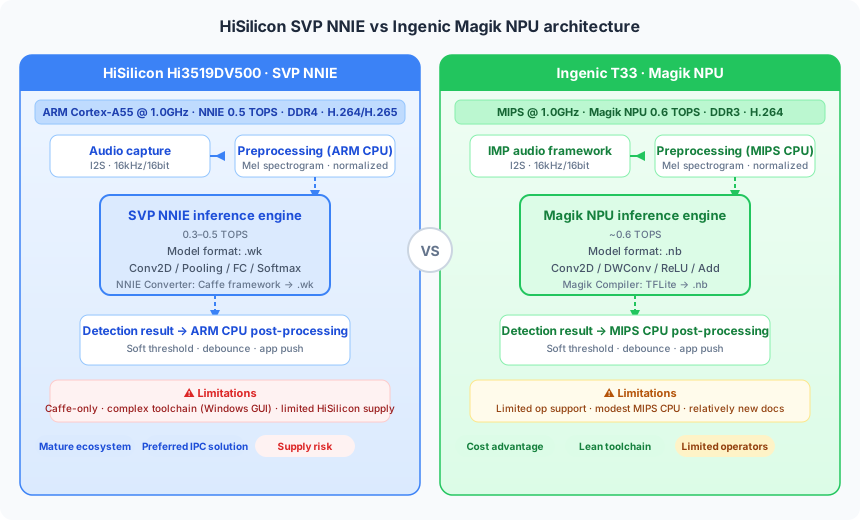
The SDK abstracts both backends behind one API — develop on a generic ARM board, deploy to either NPU without changing application code. Pure-CPU deployment remains available on ARM/MIPS/x86 when no NPU is present.
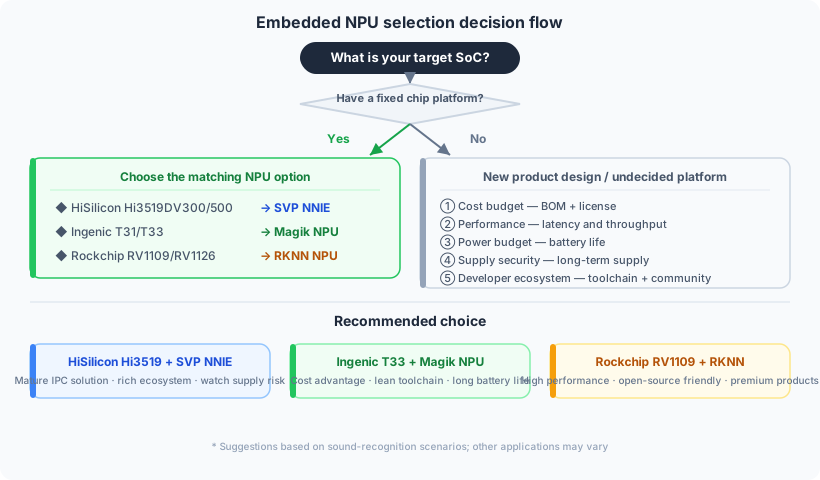
Integration Path: From Evaluation to Deployment
1. Try online — upload your own audio and check detection quality
2. Get the trial SDK — full-feature trial license with pre-compiled libraries
3. Integrate — one C API; typical integration is measured in days
4. Validate — run field trials on real hardware and microphones
5. License — per-device licensing with OTA model upgrades
Deployment Practices That Keep Products Healthy
License binding — — bind to device unique ID with offline verification
OTA model updates — — update models without flashing firmware; keep a fallback
Watchdog resilience — — auto-restart detection without affecting the main application
Continuous improvement — — field samples reported by integrators feed directly back into development; models and thresholds keep improving via OTA
Performance monitoring — — log inference latency and CPU usage; alert on drift
Conclusion
Nine sounds, one SDK — offline sound recognition delivered as a component, without building an ML team. Whether you are adding one capability to a doorbell or building multi-sound sensing on an IPC, start with the live demo; our engineers will help you from evaluation to deployment.
Want to try the detection yourself?
Continue Reading
- Baby Cry Detection: Offline Embedded Cry Recognition SDK for Edge Devices
- Embedded Glass Break Detection: Offline Break Recognition SDK and Deployment
- Embedded Gunshot Detection: Offline Gunshot Recognition SDK for Public Safety
- Embedded Cat Sound Detection: Offline Meow Recognition SDK with Cry Discrimination