Smart Baby Monitors: Beyond Video, Sound Is the Key
Walk into any electronics store today, and you'll see baby monitors boasting 2K resolution, pan-tilt-zoom, night vision, and Wi-Fi connectivity. Yet nearly all of them share the same limitation: they simply stream video to parents, expecting a human to watch 24/7.
Adding intelligent sound detection transforms a passive camera into an active alerting device. Here's why sound matters more than video for baby monitors — and what it takes to get it right.
The Problem with Video-Only Monitors
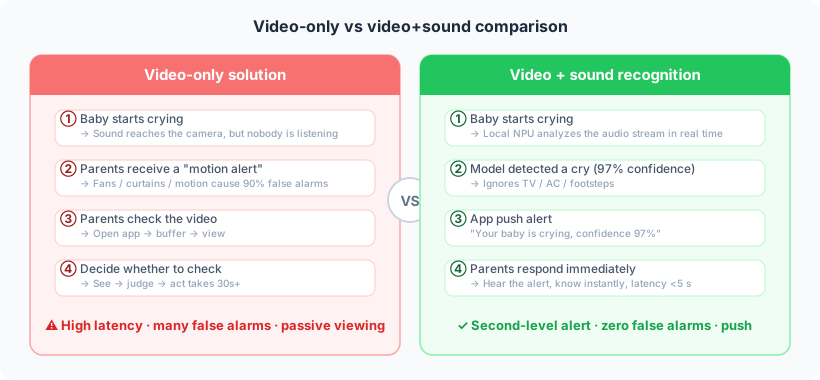
A typical video baby monitor workflow:
1. Baby cries
2. Parent glances at the video feed (or receives a motion alert triggered by the baby moving)
3. Parent realizes the baby is crying
4. Parent goes to the nursery
The gap between step 1 and step 2 is the critical problem. Parents aren't staring at the monitor screen all day. When they do check, they see video — but video can't tell them what's happening. Is the baby crying, laughing, or just babbling? Is it a distress cry or a sleepy fuss?
Modern "motion detection" features make things worse: they trigger on any movement — a ceiling fan, curtains blowing in the breeze, parents walking past the camera. The result is alert fatigue. Parents quickly learn to ignore notifications.
Sound Detection Solves This
A baby cry detection engine running on the monitor itself changes the equation:
Active alerting, not passive streaming. Instead of "here's a video stream, you watch it," the monitor says "your baby is crying, confidence 97%." It pushes an alert rather than requiring the parent to pull information from a video feed.
No more false motion alerts. A baby monitor with cry detection ignores the curtain blowing in the wind. It ignores the ceiling fan. It triggers only on the sound that matters — infant crying. This eliminates the alert fatigue that plagues motion-based systems.
Works when video doesn't. Night vision has limited range. The camera may be positioned at an angle. The baby might be facing away. But sound works regardless — through blankets, in the dark, from any direction.
Covers the blind spots. Many baby monitors don't cover the entire crib area. A wide-angle lens still has blind corners. Sound fills the room; a microphone picks up crying regardless of where the baby is positioned.
The Technical Challenge
Making cry detection work reliably on a baby monitor is harder than it sounds. Here are the specific challenges our team solved over multiple generations of model training:
Challenge 1: Distance variability. A baby monitor might sit 1 meter from the crib or 5 meters across the room. The model must handle massive variation in input level and room acoustics. Our solution: multi-distance training data augmentation, ranging from near-field to far-field recordings.
Challenge 2: Parent noise. Parents talking, walking, opening doors, running appliances — the model must distinguish infant crying from similar-frequency household sounds. We collected 8,000+ hours of household audio for negative sample coverage.
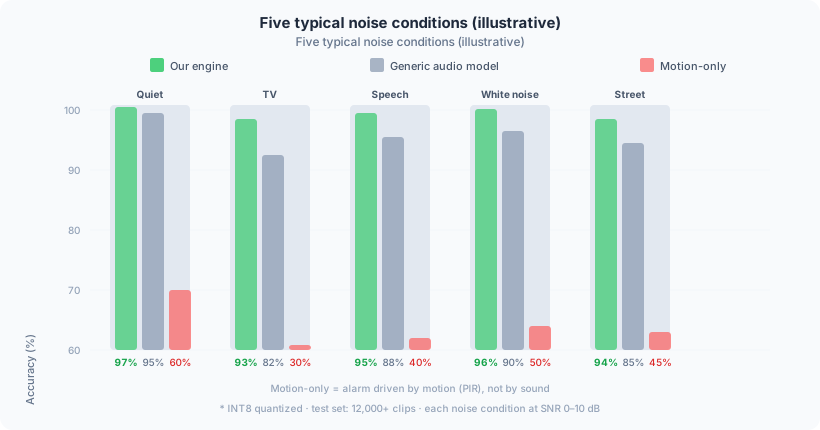
Challenge 3: TV and audio interference. In our field tests, TV background was the single largest source of false positives. Cartoons and children's shows are especially problematic because their audio spectrum overlaps with infant crying. Our model uses targeted augmentation with TV/music mixing at various SNR levels.
Challenge 4: Multiple babies. Twin monitors, daycare settings — the model must work when multiple infants are in the same room. Our test set includes overlapping cry scenarios.
Challenge 5: Real-time requirement. The detection must run continuously on the device's main SoC without affecting video streaming performance. Our model achieves under 10ms inference per window on ARM Cortex-A53, using approximately 30 MHz of CPU — leaving ample headroom for video encoding and network streaming.
What to Look for in a Baby Cry Detection SDK
If you're integrating cry detection into your baby monitor product, evaluate vendors on these criteria:
The Market Opportunity
The global baby monitor market was valued at approximately $2.5 billion in 2025 and is projected to grow at 7-8% CAGR through 2030. Within this market, smart/connected baby monitors are the fastest-growing segment — and within that segment, AI-enhanced features are the key differentiator.
Products with intelligent sound detection command a 30-50% price premium over basic video monitors. For manufacturers, the incremental BOM cost of adding cry detection (software license + microphone, if not already present) is minimal compared to the retail price uplift.
Beyond Baby Cry: Building a Platform
A sound detection SDK on your baby monitor opens the door to additional features using the same hardware:
Snore detection — Monitor parent sleep quality when the device is used in the master bedroom
Glass break detection — Turn the monitor into a home security device when the child is not home
Alarm detection — Detect smoke alarms and CO alarms as an additional safety layer
Sound level monitoring — Track nursery noise levels and sleeping patterns over time
Each additional capability uses the same microphone, the same SoC, and the same SDK framework — making it a high-margin software add-on for your product roadmap.
Conclusion
Video is table stakes for a modern baby monitor. Sound intelligence is the differentiator that turns a commodity camera into an indispensable parenting tool. With today's embedded AI models, adding cry detection requires no cloud connectivity, no additional hardware beyond the existing microphone, and no noticeable impact on battery life or video performance.
The next generation of baby monitors won't just show parents what's happening — they'll understand it.
Want to try the detection yourself?